
- Part1: [The History of Korea and the Moon Jar (1)]
– On the origins and the cultural significance of white.
The Birth of the Moon Jar:
From the Beloved White of the Korean People
Following the era of vibrant and intricate Goryeo Celadon, white porcelain began to emerge, taking center stage by the late 14th and 15th centuries. The Neo-Confucian ideal of inner purity, which we explored in Part 1, fundamentally reshaped the aesthetic of Korean ceramics. Rather than outward decoration, the focus shifted to the modest and clean nature of white.
Initially, the royal court claimed white porcelain for its exclusive use, but it soon spread to the ruling class, known as the Yangban (scholar-officials). By the 17th century, as ceramic kilns spread across the entire country, white porcelain finally reached the homes of commoners, becoming the defining vessel of the Korean people.
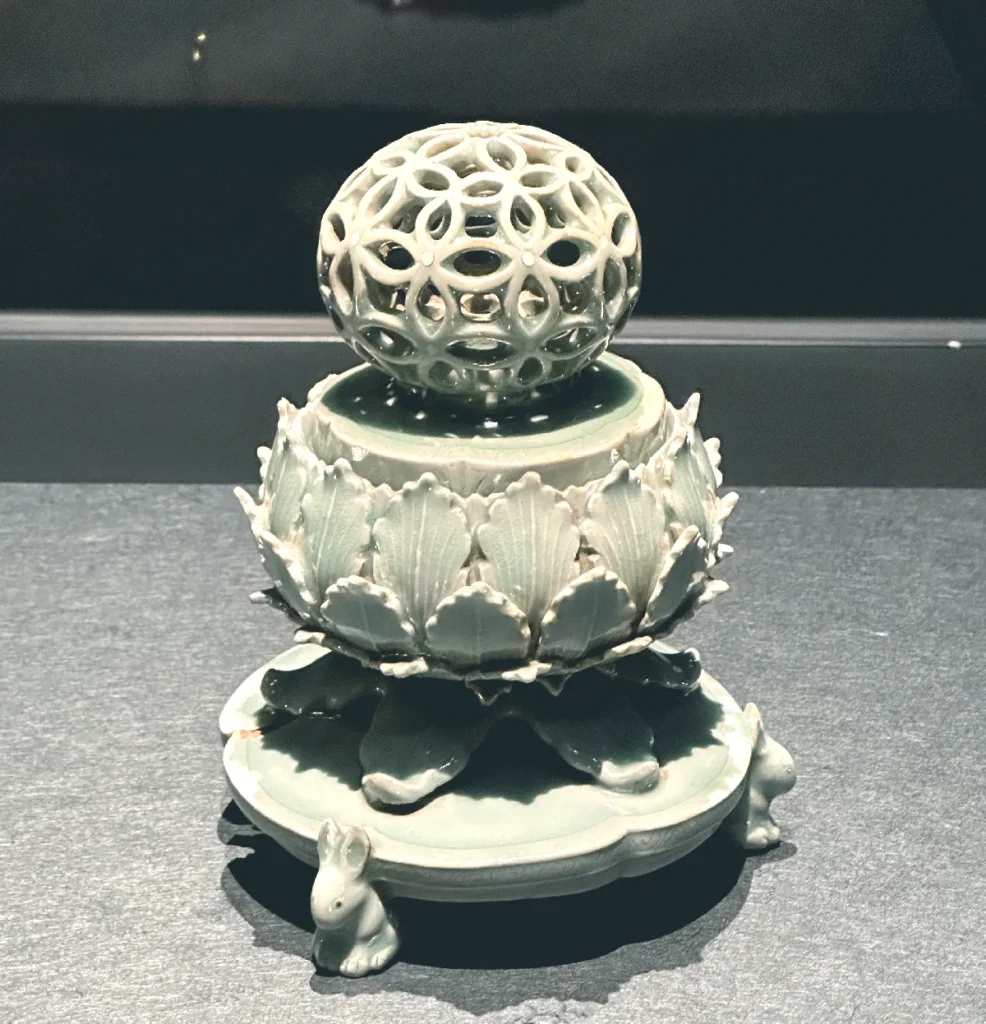
A glimpse into the vibrant era of celadon that preceded white porcelain.
Photographed at the National Museum of Korea. (2024)
The Philosophy of the Era Carved into the Moon Jar
In the late 17th and 18th centuries, Korea enjoyed a “cultural renaissance” led by Neo-Confucianism. At first, only the royal court and the ruling class (Yangban) used these jars. But soon, 18th-century scholars began to see them as more than just containers. They used two special words to describe the Moon Jar: Wonman-gujok (圓滿具足)and Heoryeong-saengbaek(虛靈生白).
These terms define the ideal human character as pursued by Neo-Confucianism.
Wonman-gujok(圓滿具足):
This describes an ideal person whose wisdom and goodness are so full that they radiate a peaceful, generous energy. In Korean thought, scholars imagined this state of absolute ‘perfection’ as a perfect circle, round and lacking nothing just like a full moon.
Heoryeong-saengbaek(虛靈生白):
This refers to a mind that is physically “empty” (representing material integrity and purity) yet so clear and refined that it illuminates the truth of all things.
To these scholars, the Moon Jar was a visual version of this “empty yet shining” dream. It was more than just a tool for food. They loved the jar because even its outer appearance was modest and pure, free from any greedy decoration. Because it was so empty and clean, both inside and out (integrity), it could shine with a round and bright energy (wisdom). It was a masterpiece that showed how being simple and clear can lead to a spirit that is truly full.
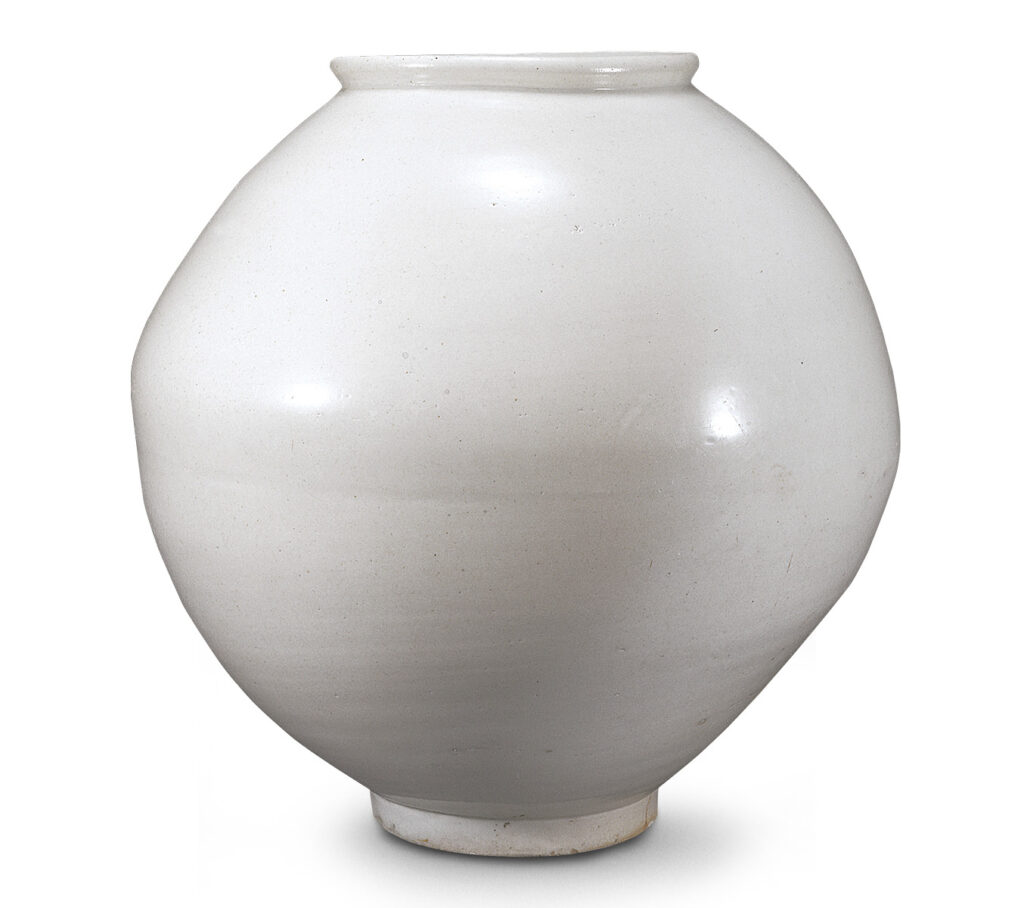
It was produced at the royal kiln complex during the early 18th century.
© National Heritage Administration, Republic of Korea.
Practicality and Modern Identity
Regarding its practical uses, small Moon Jars functioned like miniature versions of outdoor storage jars. They held expensive ingredients such as honey or oil, with the tops covered in cloth or paper and secured with string.
Large Moon Jars are defined as those exceeding 40cm in height. These grand vessels served ceremonial purposes, holding liquor, oil, or water. At other times, they acted as elegant vases for flower arrangements.
Yet, throughout this entire history, people did not call it a “Moon Jar.” They simply called it a “large white jar” (Baekja Daeho , 白磁大壺). There was no special name for it because these jars were so common in daily life. People used them everywhere in the kitchen to store grains, oil, or vinegar. Because they were such ordinary, everyday objects, no one felt the need to give them a poetic name.
- Part1: [The History of Korea and the Moon Jar (1)]
– On the origins and the cultural significance of white. - Part2: [The History of Korea and the Moon Jar (2)]
– The Philosophy and Daily Life within the Moon Jar. – Currently Reading - Part3: [The History of Korea and the Moon Jar (3)]
– A Name Born of Resilience and Lyrical Beauty. – Coming Soon
Image Sources
- National Museum of Korea : https://www.museum.go.kr/
- e-Museum (National Museum of Korea): https://www.emuseum.go.kr/