
- Part1: [The History of Korea and the Moon Jar (1)]
– On the origins and the cultural significance of white. - Part2: [The History of Korea and the Moon Jar (2)]
– The Philosophy and Daily Life within the Moon Jar.
Artist’s note: A Name Born of Resilience and Lyrical Beauty
Throughout our journey, we have explored the white aesthetic and the profound Neo-Confucian philosophy embedded in the moon jar. Yet, a vessel’s true power is revealed in how it survives its time. How did a simple storage jar become an enduring icon of identity amidst the trauma of colonization and war? In this final part, we uncover how the name “Moon Jar” was not merely a label, but a poetic refuge—an act of cultural resilience that transformed a daily object into a symbol of eternal peace and national identity.
A Name That Defied Suppression
During the Japanese colonial era (1910–1945), Koreans faced the systematic erasure of their language and identity, and these white porcelain jars were officially relegated to the term Marutsubo (丸壺). Following liberation, the ‘Movement to Restore Our Language’ (1945–1948) sparked a powerful effort to reclaim Korean speech in daily life.
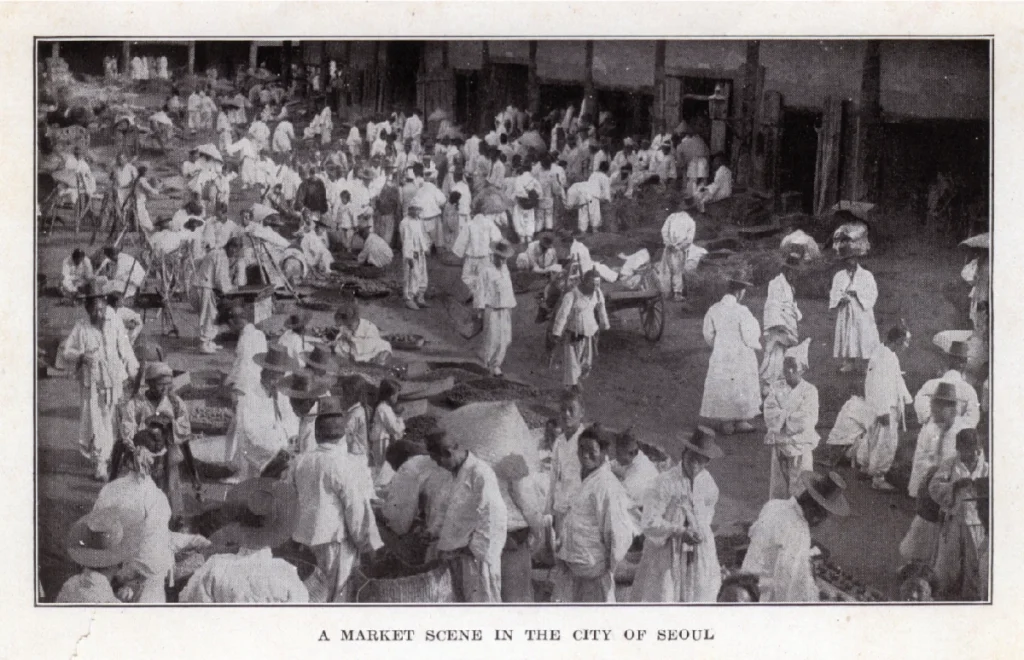
However, this joy was fleeting. The outbreak of the Korean War in 1950 brought devastating loss, leaving people to confront the terrifying possibility that their nation might vanish entirely. In those desperate times, Korean intellectuals turned inward to find strength, anchoring themselves in their own national identity. It was against this backdrop of survival that the large white porcelain jar began to be cherished with renewed intensity.
A Poetic Communion: Finding the Moon
- “On moonlit nights, I wonder how a jar can resemble the moon so closely. It feels as if the moon from billions of light-years away has come down to sit in my garden.” — WhanKi Kim, Painter
- “Gazing at this white jar, the world’s impurities seem to wash away.” — ByungHwa Cho, Poet
- “How can I not buy this jar when the very soul of our ancestors dwells within it?” — JongHwa Park, Novelist
- “Looking at the jar in my room, it feels as if the moonlight itself has pooled inside it.” — CheonMyeong No, Poet
These voices were not mere individual expressions; they represented a collective sanctuary found in the quiet, rounded form of the moon jar.
This lyrical bond between the moon and a familiar object comforted weary hearts. Through this poetic communion, the boundary between the moon and the jar blurred, thereby establishing a singular aesthetic symbol. It was in this context that Choi Sun-u, a prominent art historian and a member of that intellectual circle, used the term ‘Moon Jar’ for the first time in 1963.
“To a casual glance, it is merely a white jar. But if you gaze at it intently, it feels as if all the anxieties of the world melt away within its generous embrace.”
Ultimately, the ‘Korean pet name’ shared affectionately by those who endured oppression and war was immortalized as a symbol of eternal beauty.
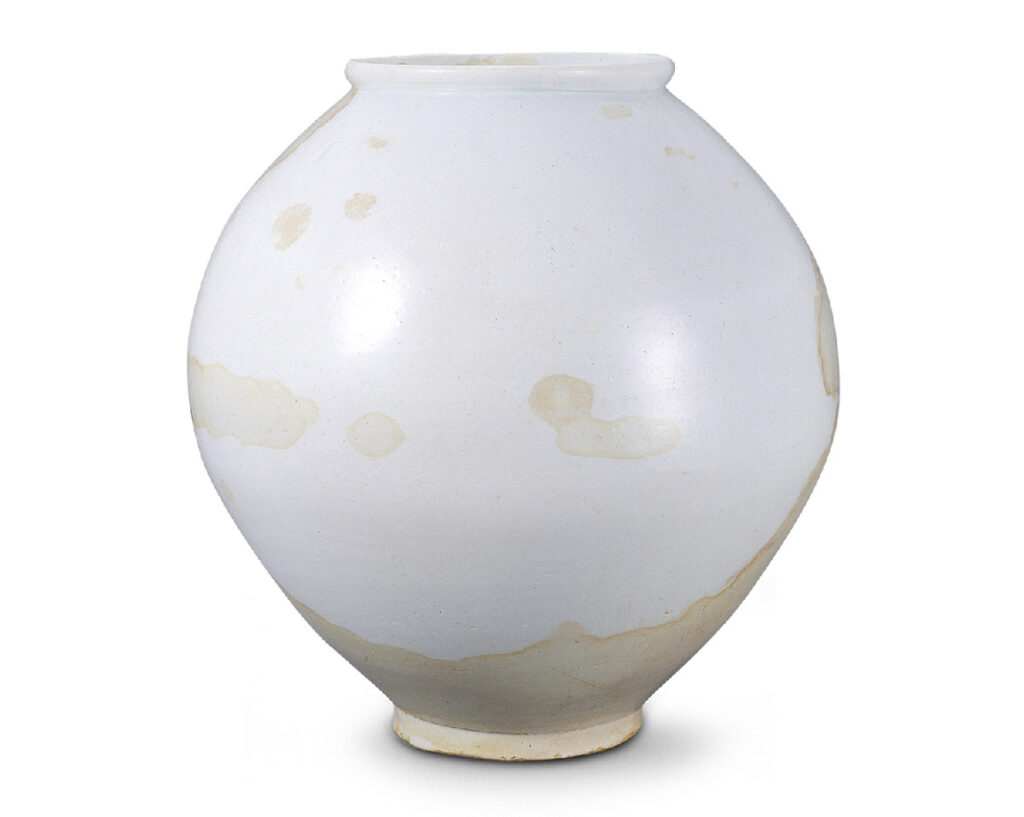
A white porcelain jar featuring natural oil stains from its historical use, showcasing the functional beauty of the Joseon era(17th–18th C.)
© National Heritage Administration, Republic of Korea.
The Aesthetics of Imperfection and Naturalness
In the late 1990s, the term ‘Moon Jar’ was officially registered in the Korean dictionary. It is a name born from a specific social background, spreading from artists and intellectuals to the heart of society.
During the Neo-Confucian era, the natural beauty of these jars was highly valued precisely for their imperfect, unadorned forms. There was no need to force them into perfect symmetry; instead, this naturalness defined their true character. Today, artists continue to honor this legacy, using traditional techniques where the potter’s strength and the kiln’s fire transform the clay into a form that breathes.
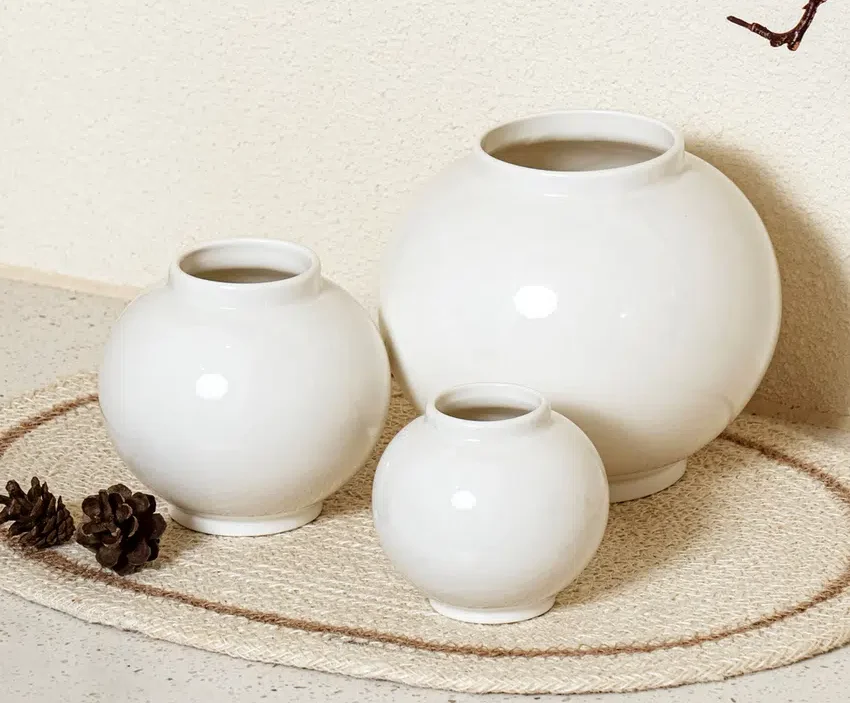
even available at local dollar stores as a beloved cultural icon. © Daiso
A Modern Symbol of Abundance and Peace
Recently, the Moon Jar has seen a profound resurgence. In Korea’s modern history, after passing through times of extreme poverty, a kitchen filled with food was a symbol of hard-won prosperity. Thus, for many, the Moon Jar today represents not only spiritual depth but also a hopeful promise of abundance and peace.
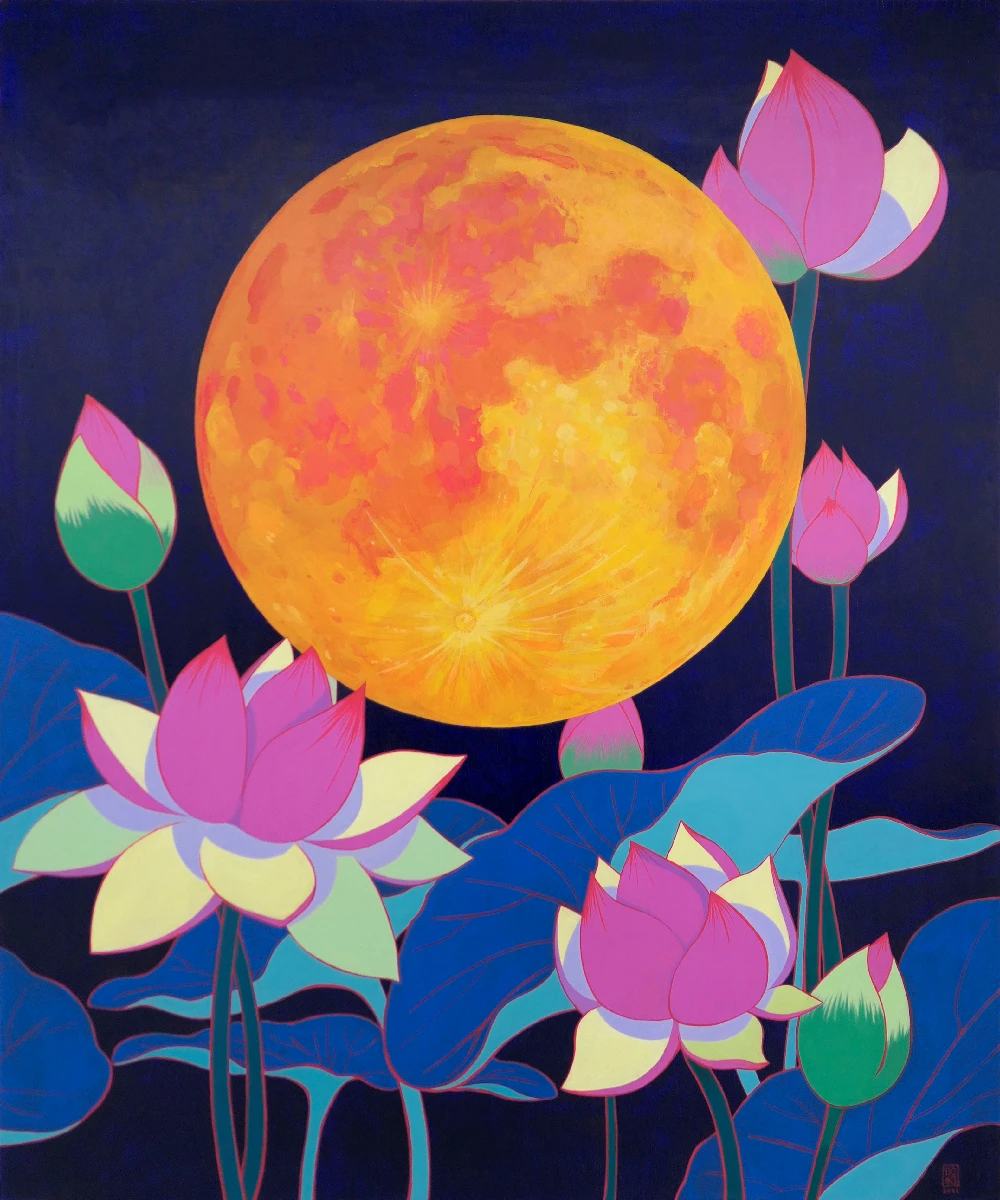
I do not paint Moon Jars, but I paint the full moon. My work may not represent the material wealth associated with the jar today, but I seek to convey the same sublimity and warmth found in both the moon and the jar. I look forward to seeing how my own ‘moon’ will continue to evolve.
The Moon Jar Series: History and Identity
- Part1: [The History of Korea and the Moon Jar (1)]
– On the origins and the cultural significance of white. - Part2: [The History of Korea and the Moon Jar (2)]
– The Philosophy and Daily Life within the Moon Jar. - Part3: [The History of Korea and the Moon Jar (3)]
– A Name Born of Resilience and Lyrical Beauty. – Currently Reading
Related Reading
Image Sources & References
Image Sources
- eoul Museum of History: https://museum.seoul.go.kr/
- National Heritage Administration: https://www.heritage.go.kr/
- Daiso (Similar to a dollar store in Korea.)
References
Historical Origins and Craftsmanship
- Song Ying-xing: Tiangong Kaiwu (The Exploitation of the Works of Nature),
- Bang Byung-sun: Ceramics- Vessels That Resemble People, Boram Publishing
- Kang Tae-chun: A Study on the Manufacturing Techniques of White Porcelain Moon Jars, Master’s thesis, Korea National University of Cultural Heritage
Symbolism of White and Neo-Confucian Aesthetics
- Kim Sang-hee: The Neo-Confucian Spirit Flowing beneath the Moon Jar, Korean Studies, Vol. 47, No. 2,
- Kim Hye-won: A Study on the Aesthetic of White in Korean Art, Master’s thesis, Kyung Hee University
- Bang Byung-sun: The Heart of Joseon Crafted in Pure White, Dolbegae Publishing
National Identity and the History of Resilience
- Soh, Hwang-Oak: TThe People of White Clothes from Modern Perspectives, International Journal of Costume and Fashion
- Choe Wan-su: The Golden Age of Our Culture: The Jingyeong Era, Dolbegae Publishing
- Kim Jae-yeol: Rewriting the History of Gyeonggi Ceramics, Gyeonggi Cultural Foundation
- Kim Whan-ki: Where, in What Form, Shall We Meet Again?, Whanki Museum
- Cultural Heritage Administration (Republic of Korea): Public Notice on the Change of Designation for Movable Cultural Heritage,
- Hong Gi-dae: Udang Hong Gi-dae: 80 Years with Joseon White Porcelain, Culturebooks Publishing
- Horlyck Charlotte: The Moon Jar: A Quintessential Korean Icon,
- Choi Sun-u: Standing Against the Entasis of Muryangsujeon, Hakgojae Publishing
- Dong-A Ilbo: Column: The Beauty of the Moon Jar,