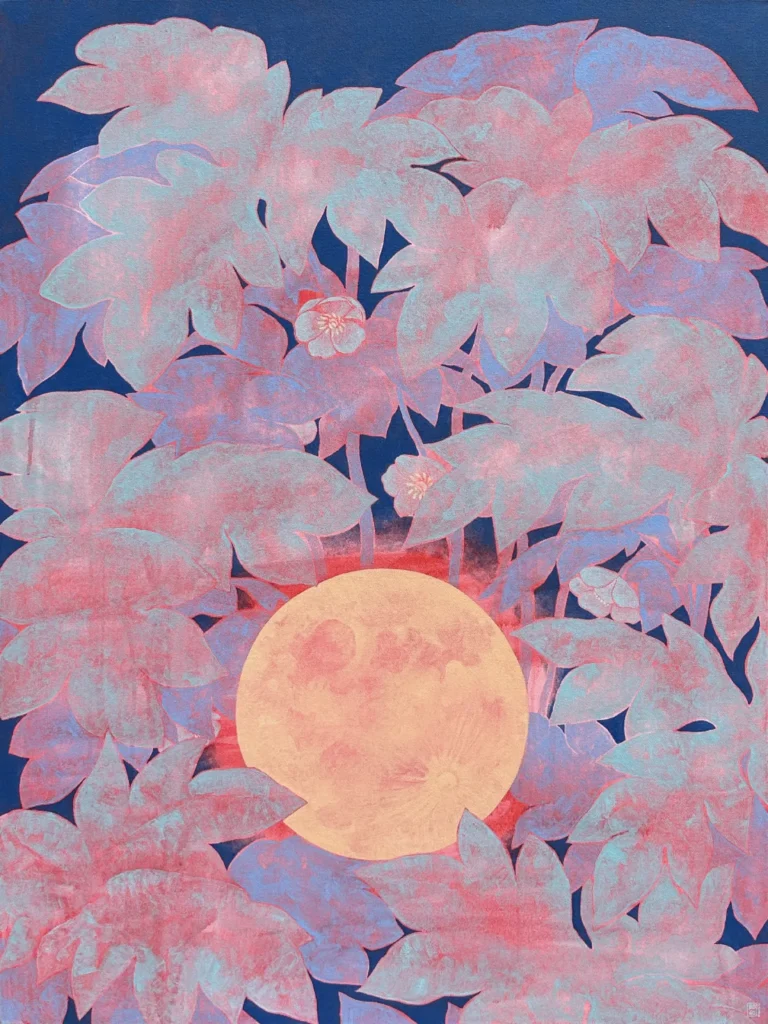
Traces of Life
“Kindness is the ability to hold our own heartbreak and continue to live, to resist, to heal, and to remain human.“
— Sandra Oh, Commencement Address at Dartmouth College, 2025
This archive is a collection of my ruminations on why I paint the moon and the flowers. Through these works, I offer a heartfelt embrace, nature’s way of holding those who stand at the edge of the world while never losing their kindness.
The Moon and The Flowers
I draw upon the moon and the flowers as companions in my journey. These stories explore why these subjects have become the primary medium through which I express my thoughts and find solace.
The Moon and The Moon Jar
The moon holds a profound place in the Korean spirit. Here, I delve into the cultural and historical resonance of the moon, exploring why it has been cherished so deeply through the lens of the ‘Moon Jar’ and our shared heritage.
- On the origins and the cultural significance of white
The History of Korea and the Moon Jar (1) - The Philosophy and Daily Life within the Moon Jar
[The History of Korea and the Moon Jar (2)] - A Name Born of Resilience and Lyrical Beauty
The History of Korea and the Moon Jar (3)]
References for the Moon Jar
Historical Origins and Craftsmanship
[Referenced in Part 1 & Part2]
- Song Ying-xing: Tiangong Kaiwu (The Exploitation of the Works of Nature),
- Bang Byung-sun: Ceramics- Vessels That Resemble People, Boram Publishing
- Kang Tae-chun: A Study on the Manufacturing Techniques of White Porcelain Moon Jars, Master’s thesis, Korea National University of Cultural Heritage
Symbolism of White and Neo-Confucian Aesthetics
[Referenced in Part 1 & Part3]
- Kim Sang-hee: The Neo-Confucian Spirit Flowing beneath the Moon Jar, Korean Studies, Vol. 47, No. 2,
- Kim Hye-won: A Study on the Aesthetic of White in Korean Art, Master’s thesis, Kyung Hee University
- Bang Byung-sun: The Heart of Joseon Crafted in Pure White, Dolbegae Publishing
National Identity and the History of Resilience
[Referenced in Part 1 & Part 3]
- Soh, Hwang-Oak: TThe People of White Clothes from Modern Perspectives, International Journal of Costume and Fashion
- Choe Wan-su: The Golden Age of Our Culture: The Jingyeong Era, Dolbegae Publishing
- Kim Jae-yeol: Rewriting the History of Gyeonggi Ceramics, Gyeonggi Cultural Foundation
National Identity and the History of Resilience
[Referenced in Part 3]
- Kim Whan-ki: Where, in What Form, Shall We Meet Again?, Whanki Museum
- Cultural Heritage Administration (Republic of Korea): Public Notice on the Change of Designation for Movable Cultural Heritage,
- Hong Gi-dae: Udang Hong Gi-dae: 80 Years with Joseon White Porcelain, Culturebooks Publishing
- Horlyck Charlotte: The Moon Jar: A Quintessential Korean Icon,
- Choi Sun-u: Standing Against the Entasis of Muryangsujeon, Hakgojae Publishing
- Dong-A Ilbo: Column- The Beauty of the Moon Jar,